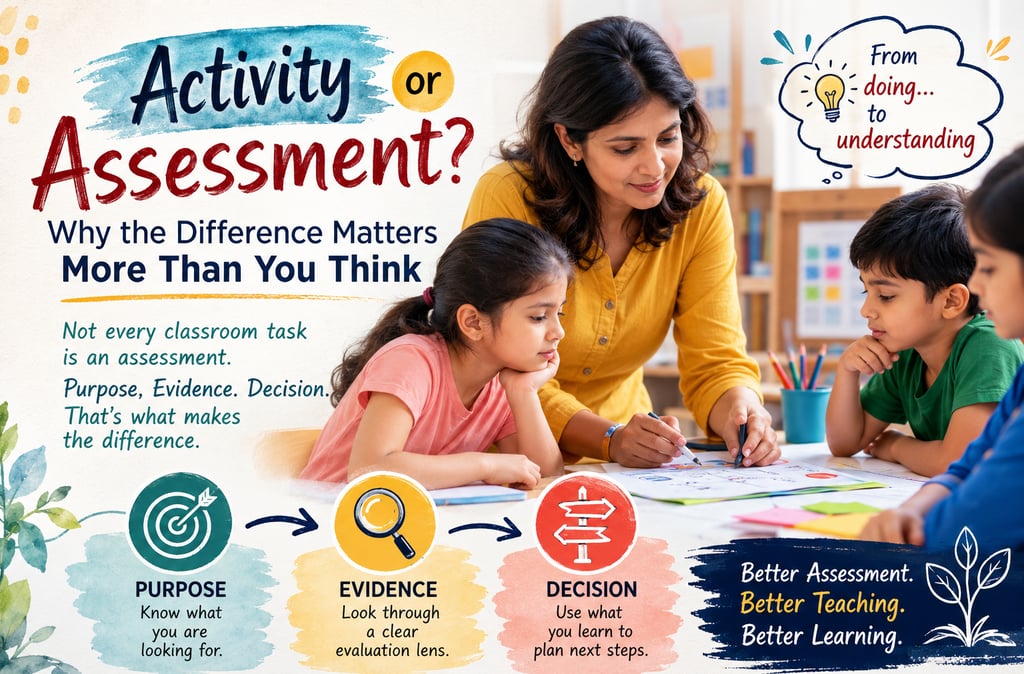
Activity or Assessment? Why the Difference Matters More Than You Think
Many classroom tasks look like assessments—but are they really? In this thought-provoking article, discover the critical difference between an activity and an assessment, why it matters for student learning, and how three simple shifts can transform everyday classroom experiences into meaningful assessments that inform teaching. With practical examples, reflection questions, and actionable strategies, this blog will help educators design assessments that truly capture understanding rather than simply measure completion. Category: Assessment for Understanding Published on: tannusconceptcorner.com | Idea Hub Series: Assessment for Understanding
Tannu Jain
7/2/20266 min read
Activity or Assessment? Why the Difference Matters More Than You Think
## A question I ask every teacher I work with
When I run professional development sessions, I often begin with a simple exercise. I describe five classroom scenarios — a gallery walk, a group discussion, a written reflection, a sorting task, a student presentation — and I ask teachers to sort them into two piles: activity or assessment.
The room always gets quiet.
Not because the question is difficult. But because most educators realise, mid-sort, that they don't actually have a clear answer. They've been doing both all along — often in the same lesson, sometimes in the same task — without a consistent framework for telling them apart.
And that uncertainty matters. Because if we don't know when we're assessing, we can't know what evidence we're gathering. And if we don't know what evidence we're gathering, we can't use it to make better decisions about teaching and learning.
---
Why the line feels blurry
The confusion between activity and assessment is not a sign of poor practice. It's a sign that our classrooms are rich enough that learning and evidence of learning often happen simultaneously.
A student presenting their inquiry project is learning to communicate, consolidate, and transfer. But if a teacher is watching with clear criteria in mind, capturing specific observations, and using what they see to inform the next instructional decision — that same presentation is also an assessment.
The task hasn't changed. What changed is the intention behind it and the use of what it produces.
This is the key insight: the difference between an activity and an assessment is not always what the student does. It is what the teacher does with it.
So what actually makes something an assessment?
An assessment, in the fullest sense of the word, has three non-negotiable elements:
1. A clear purpose
Before the task begins, the teacher knows what they are looking for. Not in general terms — not "engagement" or "effort" — but specifically. What understanding are we checking? What skill should be visible? What conceptual thinking should emerge?
Without a clear purpose, we are observing. Not assessing.
2. An evaluation lens
The teacher has criteria — explicit or internalised — for reading what they see. This might be a co-constructed success criteria, a set of evaluation descriptors, or a clear mental model of what strong understanding looks and sounds like versus partial or emerging understanding.
Without an evaluation lens, we are watching. Not assessing.
3. Evidence that informs a decision
What the student produces — in writing, in conversation, in action, in a drawing, in a discussion — becomes evidence that the teacher uses to make a decision. What does this student need next? What does this pattern across the class tell me about my teaching? What do I need to revisit, restructure, or extend?
Without a decision that follows, we have data. Not assessment.
Assessment, properly understood, is a cycle — purpose, observation, evaluation, decision. An activity is a valuable learning experience that may or may not feed that cycle.
The three-question test
Here is a practical tool you can use right now to determine whether any classroom task is functioning as an assessment:
Question 1: Before the task, did I know exactly what I was looking for?
Not in broad strokes. Specifically. What understanding, what skill, what evidence of conceptual thinking?
Question 2: During or after the task, did I evaluate what I saw against clear criteria?
Was I reading student responses, behaviours, or products through a lens that helped me distinguish strong understanding from partial understanding from misconception?
Question 3: After the task, did what I found change anything about what I'll do next?
Not eventually. Soon. In the next lesson, the next task, the next conversation with that student or group.
If the answer to all three is yes — you were assessing.
If the answer to any one is no — you had a valuable learning activity. Which is worthwhile. But it is not assessment.
Turning any activity into an assessment in 3 moves
The good news is that the distance between a rich activity and a meaningful assessment is often smaller than we think. Here are three moves that make the shift:
Move 1: Clarify what you're looking for before the task begins
Take the gallery walk. Before students begin, ask yourself: what would it look like if a student understood the concept deeply? What would partial understanding look like? What would a misconception look like? Write it down. Even three bullet points. This becomes your evaluation lens.
Move 2: Add a thinking prompt that makes understanding visible
Most activities produce output — a poster, a discussion, a sorted set of cards. But output alone doesn't reveal thinking. Add one prompt that requires students to explain their reasoning: *"Why did you place this here?"* *"What connection are you making?"* "If this changed, what else would change?" That reasoning is where understanding lives.
Move 3: Build in a capture moment
Teacher observation is valid assessment data — but only if you capture it. After a discussion or a group task, take two minutes to jot down what you noticed: who struggled with what, who surprised you, what question came up that you didn't expect. That note becomes micro data — immediate, lesson-level evidence that informs your very next move.
A classroom example: the sorting task
Let's make this concrete. A Grade 3 teacher has students sort a set of picture cards into "living" and "non-living" categories. Students work in pairs, discuss, and place their cards.
As an activity, this is a perfectly good learning experience. Students are engaging with vocabulary, practising categorisation, and having a conversation about science concepts.
But watch what happens when we apply the three moves:
Before the task, the teacher identifies that she wants to check whether students understand that living things carry out life processes — not just that they move or grow. That's her evaluation lens.
During the task, she adds a prompt: "Tell me the one thing all living things have in common." This surfaces the understanding, not just the categorisation.
After the task, she notes down which three pairs gave a definition rooted in life processes, which four defaulted to "they move," and which pair placed a flame in the "living" column. That's her micro data.
Tomorrow she has a targeted conversation with the four pairs who think movement equals life. The next day she plans a quick experience with seeds — things that are alive but don't visibly move — to deepen the understanding.
Same task. Completely different impact. Because she treated it as assessment.
---
## The five scenarios — let's sort them
Here are five classroom situations. Apply the three-question test to each:
**Scenario A:** Students complete a worksheet on plant parts, labelling diagrams from memory.
*Three-question test: Purpose — likely yes. Evaluation lens — probably basic. Decision — unlikely, it'll probably be marked and returned.*
**Verdict: Activity with assessment potential. Needs a clearer evaluation lens and a response plan.**
**Scenario B:** A teacher listens to a reading group and uses a running record to note which words a student self-corrects, which they skip, and which they misread — then plans the next guided reading session accordingly.
*Three-question test: Purpose — yes. Evaluation lens — yes. Decision — yes.*
**Verdict: Assessment. Clear, purposeful, and immediately useful.**
**Scenario C:** Students create a poster about their inquiry topic and present it to the class.
*Three-question test: Purpose — unclear without criteria. Evaluation lens — often absent. Decision — rarely happens.*
**Verdict: Typically an activity. Could become powerful assessment with criteria and a follow-up decision.**
**Scenario D:** A teacher asks students to write an exit ticket: "What's one thing you understood today and one thing you're still unsure about?"
*Three-question test: Purpose — yes. Evaluation lens — yes, built into the prompt. Decision — yes, if the teacher reads them before tomorrow.*
**Verdict: Assessment. Simple, fast, and genuinely useful.**
**Scenario E:** Students participate in a Socratic seminar about a historical dilemma, sharing perspectives and building on each other's ideas.
*Three-question test: Purpose — depends on whether the teacher has identified specific understandings to listen for. Evaluation lens — depends on whether there are criteria for what strong reasoning sounds like. Decision — depends.*
**Verdict: Activity or assessment depending entirely on teacher preparation.**
---
## Teacher takeaway
Print or save this three-question card and keep it in your planning space. Before any task, ask:
**Before:** What specifically am I looking for?
**During/After:** What lens will I use to evaluate it?
**Next:** What will I do differently based on what I find?
If you can answer all three before the task begins — you've designed an assessment.
If you can only answer one or two — you have a strong activity. Consider what one additional move would take it further.
---
## Closing reflection prompt
Think of one task you've done in the past week that you called an assessment. Apply the three-question test honestly.
**Was it an assessment? Or was it a rich activity that felt like one?**
There is no wrong answer — only a more honest starting point for what you design next.
*Next in the series: Blog B03 — What are you actually looking for? Framing evaluation criteria using K.U.D.*
*Explore more on the Idea Hub at tannusconceptcorner.com*
---
**About the author:** Tannu Jain | tannusconceptcorner@gmail.com