
Assessment Is the Starting Point, Not the End — 4 Principles Every Educator Must Rethink
Discover why assessment should be the starting point of learning, not the end. Explore four practical principles that help educators design meaningful assessments, interpret evidence effectively, improve teaching decisions, and create a classroom culture where assessment supports continuous student growth. Category: Assessment for Understanding Published on: tannusconceptcorner.com | Idea Hub Series: Assessment for Understanding
Tannu jain
6/27/20268 min read
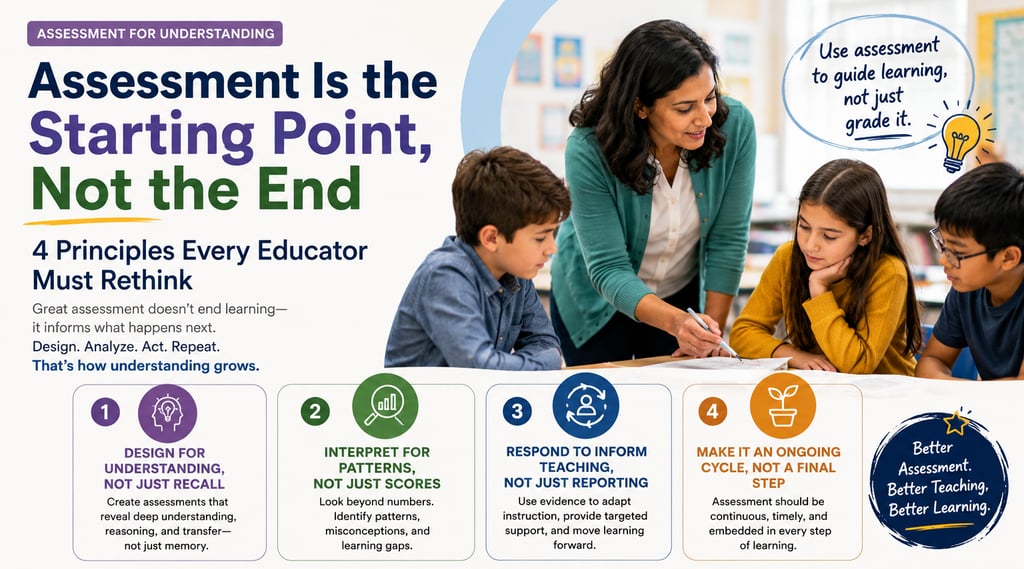

Category: Assessment for Understanding Published on: tannusconceptcorner.com | Idea Hub Series: Assessment for Understanding — By Tannu Jain
Assessment Is the Starting Point, Not the End — 4 Principles Every Educator Must Rethink
The question that changed how I think about assessment
A few years into my teaching practice, I sat in a marking session surrounded by student work. I had a red pen in one hand, a rubric in the other, and a quiet sense of dread I couldn't quite name.
I was doing everything right. Grading carefully. Writing comments. Checking learner reflections. Entering grades into a spreadsheet. By every external measure, I was being a thorough, responsible educator.
But something felt wrong.
I kept asking myself: what happens next? The unit was over. Reports were due. The grades would be recorded, shared with parents, and filed away. And the students — the ones who hadn't quite understood, the ones who'd made the same conceptual error three questions in a row, the ones who'd clearly known the content but had fallen apart under the pressure of a timed task — would move on to the next unit. Carrying the same gaps. And I would move on with them.
It was only later that I could name what felt wrong. I had been treating assessment as an ending. A full stop at the bottom of a unit. A way to measure what had happened and report it.
But assessment is not the end. It is, and always should be, the starting point.
Why we got assessment backwards
Most of us were taught — by the systems we trained in, by the schools we observed, by the culture of education we inherited — that assessment is what you do when learning is done.
Teach. Practise. Assess. Report. Repeat.
This sequence makes logical sense on the surface. But it hides a critical flaw: by the time assessment happens, it's too late to do anything meaningful with what it reveals. The unit is closed. The teaching decisions have already been made. The data sits in a gradebook, not in a lesson plan.
The result? Assessment tells us what happened. But it does nothing to change what happens next.
This is the shift that matters most for educators working in concept-based and inquiry-driven classrooms. We are not just teaching content that can be recalled and reported. We are developing understanding — and understanding is not a destination. It is a living, growing, sometimes fragile thing that needs to be tended to throughout the learning journey, not evaluated at the end of it.
When we flip assessment from an ending to a starting point, everything changes. We start asking different questions. We look for different things in student work. We respond differently to what we find. And — most significantly — our teaching changes while it can still make a difference.
The 4 principles of assessment that matters
Over years of practice, facilitation, and learning alongside educators across the globe, I've come to organise this shift around four principles. They are not complicated. But they are demanding — because they require us to change not just what we do, but what we believe assessment is for.
Principle 1 — Assessment: Design for understanding, not just recall
How am I checking if my students are learning? Do I design assessments that show understanding, not just recall?
The first principle begins before a task is ever placed in front of a student. It begins in the design.
Most assessments — even well-intentioned, carefully constructed ones — are designed to measure recall. Can the student name the water cycle stages? Can they identify the theme? Can they solve the equation? These are legitimate things to know. But they are the floor of learning, not the ceiling.
Understanding is different from recall. Understanding is what happens when a student can take knowledge and do something new with it — connect it to a different context, use it to explain a phenomenon they've never seen before, argue for or against a position using it as evidence. Understanding is transferable. Recall is fixed.
When we design assessments that ask only for recall, we get data about memory. When we design assessments that ask for understanding, we get data about thinking — and that is the data that tells us something meaningful about learning.
The question to ask before designing any assessment task is not what do I want students to produce? It is what do I want to know about their understanding? Everything flows from that distinction.
Educator reflection: Look at your last assessment task. How many questions required genuine understanding — justification, reasoning, transfer — rather than recall of facts or reproduction of a taught process?
Principle 2 — Analysis: Interpret for patterns, not just scores
How do I interpret results quickly and meaningfully? Am I looking for patterns, misconceptions, and learning gaps?
Once assessment data exists, most educators do one of two things with it: they record it, or they return it. A grade goes into a spreadsheet. A marked paper goes back to a student. And that is where the data's life ends.
The second principle asks for something more: active interpretation.
A score tells you very little on its own. A score of 14 out of 20 could mean a student has strong understanding but weak recall of facts. Or strong recall but weak reasoning. Or strong reasoning but poor procedural execution. Or genuine understanding disrupted by careless errors on a day when they were unwell. The number doesn't know the difference. Only you do — if you look carefully enough.
What we need to do after assessment is not record results. It is read them. We need to look across the class and ask: where are the patterns? What is multiple students getting wrong in the same way? Is the error conceptual — a misunderstanding of the big idea? Procedural — a breakdown in how they applied a process? Factual — inaccurate recall? Or careless — attention failures rather than learning gaps?
These are not the same problem, and they do not call for the same response. Interpreting the source of an error — not just the presence of one — is what turns assessment data into instructional intelligence.
Educator reflection: After your last assessment, did you look for patterns across students, or did you focus on individual scores? What might you have missed?
Principle 3 — Action: Respond to evidence while it still matters
What do I change in my teaching based on this evidence? Do I reteach, differentiate, or adapt strategies the right way?
The third principle is where assessment finally earns its value. Not in the design, not in the analysis, but in what changes as a result.
This is also where most educators hit a wall. They see the patterns. They understand that 60% of their students misapplied a key skill. They know that a small group has a conceptual gap that the rest of the class does not. And then... the next unit begins. Because there is always a next unit. Because the curriculum keeps moving. Because there is no time.
But this is a false economy. Time spent moving forward without addressing learning gaps is time building a tower on an unstable foundation. The conceptual misunderstanding from this unit will compound in the next. The procedural error that wasn't addressed will show up again, more deeply entrenched.
Acting on assessment evidence means pausing — sometimes briefly, sometimes significantly — to respond to what the data is telling us. It might mean a small-group session for students who share a specific gap. It might mean redesigning the next task to approach the same understanding from a different angle. It might mean having a whole-class conversation about an error pattern before moving on.
What it always means is this: the next instructional decision should be informed by the last piece of evidence. Assessment that doesn't change teaching is not assessment. It is paperwork.
Educator reflection: Think of the last time assessment evidence genuinely changed what you did the following lesson or week. How often does that actually happen in your practice?
Principle 4 — Culture: Build an environment where assessment grows learners
Is assessment in my classroom about growth or just grades? Do students see assessment as a tool to help them improve? Am I building trust where feedback leads to progress?
The fourth principle operates at a different level from the other three. It is not about a single task or a single analysis or a single instructional response. It is about what assessment means in your classroom — the invisible agreement between you and your students about what happens when learning is made visible.
In many classrooms, that invisible agreement sounds something like this: we assess you, we give you a number, you receive it, we move on. Assessment is something that happens to students, not something they are part of. It is a judgment, not a conversation. A grade, not a mirror.
Building an assessment culture that genuinely grows learners means disrupting that agreement. It means involving students in understanding what they're being assessed on and why. It means designing feedback that points forward — that shows a student not just where they are, but what to do next. It means creating safety around the idea that an error is information, not a verdict.
Assessment-capable learners don't wait to be told how they did. They develop the habit of asking: What do I understand well? What is still unclear? What would I do differently? That metacognitive capacity — the ability to read one's own learning — is one of the most powerful outcomes any educator can cultivate. And it only grows in classrooms where assessment is genuinely in service of learning, not just measurement of it.
Educator reflection: If you asked your students right now what assessment is for, what would they say? And would their answer match what you believe?
Putting it together: the honest audit
These four principles — Assessment, Analysis, Action, Culture — are not a new programme to implement. They are a lens to look at what you already do and ask: is this serving learning, or just recording it?
Before reading further in this series, I'd like to invite you to do something uncomfortable: the honest audit.
Look at your current practice and consider which of these statements ring true:
I use assessment mainly for reporting, not for guiding my next steps.
My feedback often comes too late for students to act on it.
I analyse results, but I rarely change my teaching in response.
Students in my class see assessment as something that happens to them.
I design assessments because they're expected, not because they'll tell me something I need to know.
There is no shame in any of these. They are the natural result of the systems most of us were trained in and continue to work within. But naming them is the first step toward changing them.
Teacher takeaway: the reset checklist
Use this at the start of any unit or term to audit where you are and what you want to strengthen.
Assessment (Design)
Does my assessment task require understanding, not just recall?
Will student responses tell me something meaningful about their thinking?
Analysis (Interpretation)
Do I have a protocol for reading errors — not just marking them?
Am I looking for patterns across the class, not just individual performance?
Action (Response)
Do I plan time to respond to assessment evidence before moving on?
Is my feedback actionable — does it tell students what to do next?
Culture (Environment)
Do students understand what assessment is for in my classroom?
Is there psychological safety around making mistakes and learning from them?
Pick one area to focus on this term. One shift, sustained, is worth more than four changes that don't stick.
Closing reflection prompt
"If you can't measure it, you can't improve it." — Peter Drucker
But measuring alone is not enough. We must measure with purpose, interpret with intelligence, act with intention, and create a culture in which the measurement means something to the people it is supposed to serve.
Here is your closing question to sit with:
What would your assessment practice look like if every task you designed, every result you analysed, and every piece of feedback you gave was genuinely in service of the next step in learning — not the last step in a unit?
Write your answer down. Share it with a colleague. Come back to it at the end of this term and see whether it still holds.
This is not a small question. It is the question this entire series is built around. And it starts here.
Next in the series: Blog B02 — Activity or assessment? Why the difference matters more than you think.
Explore more on the Idea Hub at tannusconceptcorner.com
About the author Tannu Jain is a concept-based curriculum enthusiast, IBPYP educator with 13+ years of experience, and Trainer of the CBI Learning . She writes about assessment, inquiry, and conceptual thinking for educators at tannusconceptcorner.com. tannusconceptcorner@gmail.com