
From Curiosity to Transfer: The Missing Role of Concept Formation in Inquiry # 2: Designing for Concept Formation: Five Strategies That Help Students Discover Big Ideas
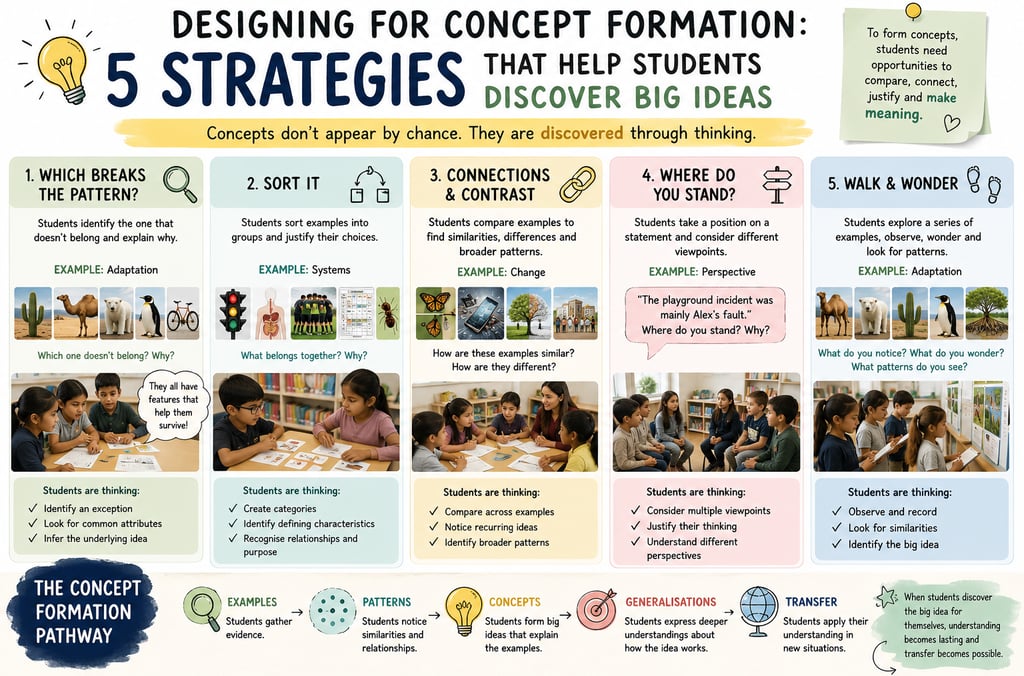
Concept formation does not happen by accident. It requires intentional opportunities for learners to analyse examples, identify patterns, make connections, and construct meaning. This article explores five practical strategies—Which Breaks the Pattern, Sort It, Connections and Contrast, Where Do You Stand, and Walk and Wonder—that help students move beyond memorising facts to discovering transferable concepts and deeper understanding.
Tannu Jain
6/15/20262 min read
From Curiosity to Transfer: The Missing Role of Concept Formation in Inquiry
# 2: Designing for Concept Formation: Five Strategies That Help Students Discover Big Ideas
One of the misconceptions about inquiry learning is that concepts emerge automatically. We assume that if students engage in an investigation, the conceptual understanding will naturally develop.
Unfortunately, this is not always the case.
Students can complete investigations, gather information, and answer questions without ever identifying the deeper idea that connects their learning. Concept formation happens when learners are intentionally supported to analyse examples, identify patterns, compare situations, justify their thinking, and construct meaning.
This is why concept formation should be designed, not left to chance.
1. Which Breaks the Pattern?
Students are presented with a collection of images, texts, artefacts, or examples and asked to identify which one does not belong.
At first glance, this appears to be a simple classification task. However, the real thinking occurs when students explain their choices.
Consider a lesson exploring adaptation. Students are shown a cactus, camel, polar bear, penguin, and bicycle.
Most students identify the bicycle as the odd one out.
But the learning does not lie in selecting the bicycle.
The learning lies in recognising that all the other examples possess features that help them survive in specific environments.
Students begin by identifying an exception and end by uncovering a concept.
The discussion shifts from:
"Which one doesn't belong?"
to
"What idea connects the others?"
That is concept formation.
2. Sort It
Sorting is one of the most powerful concept formation strategies because it requires students to create categories rather than simply recognise them.
When learners sort examples into groups, they must decide:
What belongs together?
Why does it belong together?
What characteristics define each group?
What makes the groups different?
Imagine students exploring the concept of systems.
They receive images of traffic lights, the digestive system, a football team, a school timetable, and an ant colony.
As students sort and justify their groupings, they begin noticing that each example contains multiple parts working together toward a common purpose.
The concept emerges through the act of organising and explaining.
3. Connections and Contrast
Concepts become visible when learners compare examples.
Imagine students exploring the concept of change.
They compare:
The butterfly life cycle
Technological innovation
Seasonal changes
Changes within communities
Initially, these examples appear unrelated.
However, as students analyse them, they begin noticing recurring ideas:
Things change over time.
Change may be gradual or sudden.
Change often creates new possibilities.
By comparing examples, students move beyond the details and begin recognising the larger conceptual pattern.
4. Where Do You Stand?
Some concepts emerge not from observation but from discussion.
Concepts such as perspective, fairness, power, responsibility, and conflict often require students to examine multiple viewpoints.
In a Where Do You Stand? activity, students respond to a statement, justify their thinking, and consider alternative viewpoints.
As learners listen to others, they begin recognising that people can interpret the same event differently.
The concept does not emerge because everyone agrees.
It emerges because students explore why people disagree.
5. Walk and Wonder
One challenge in concept formation is ensuring students encounter enough examples to identify a meaningful pattern.
In a Walk and Wonder activity, students move between stations, recording observations, questions, and connections.
Initially, they focus on facts.
Then they begin noticing similarities.
Finally, they identify patterns that connect the examples.
Students move from:
"What do I see?"
to
"What do these examples have in common?"
and ultimately to
"What is the big idea?"
This progression mirrors the journey from knowledge to understanding.
Download the ready to use resource task sheet from the resource library at www.tannusconceptcorner.com
Tannu Jain
Concept-Based Learning Trainer & Curriculum Consultant
Helping educators move beyond teaching topics to developing transferable understanding