
From Curiosity to Transfer: The Missing Role of Concept Formation in Inquiry # Part 1 : The Missing Stage in Inquiry: Why Concept Formation Deserves Intentional Attention Like Provocation
Most inquiry classrooms invest significant time in creating engaging provocations, but far less attention is given to how students form concepts from their learning experiences. This article explores why concept formation is the often-overlooked stage of inquiry and how it serves as the bridge between engagement and transferable understanding. Discover why moving learners from examples to patterns, concepts, and generalisations is essential for deep learning and meaningful transfer.
Tannu Jain
6/15/20263 min read
From Curiosity to Transfer: The Missing Role of Concept Formation in Inquiry
# Part 1 : The Missing Stage in Inquiry: Why Concept Formation Deserves Intentional Attention Than Provocation
Walk into most inquiry classrooms and you will find a carefully designed provocation.
A captivating image. A surprising experiment. A powerful story. A thought-provoking question.
Students are engaged. They are curious. They are asking questions.
As educators, we have become increasingly skilled at designing experiences that spark curiosity and invite learners into an inquiry. Yet, as I observe classrooms and work with teachers across schools, I often notice something interesting.
We spend a great deal of time planning the provocation, but very little time planning what comes next.
Specifically, we often overlook one of the most important stages of inquiry: concept formation.
The result is that students enjoy the learning experience, participate actively in investigations, and collect plenty of information, but they may struggle to articulate the deeper understanding behind their learning. Without concept formation, the learning often remains tied to the context in which it was taught. Transfer becomes difficult because learners have not yet identified the big idea that connects the examples.
If transfer is one of the ultimate goals of learning, then concept formation is the bridge that makes transfer possible.
Beyond Engagement
There is no doubt that engagement matters. Curiosity is the engine that drives inquiry. However, engagement alone does not guarantee understanding.
Students can spend an hour enthusiastically investigating a phenomenon and still leave without understanding the underlying concept.
Inquiry is not simply about asking questions or exploring interesting topics. Inquiry should help learners identify patterns, make connections, recognise relationships, and construct understandings that can be applied beyond the immediate context.
In a concept-based classroom, learning moves through a progression:
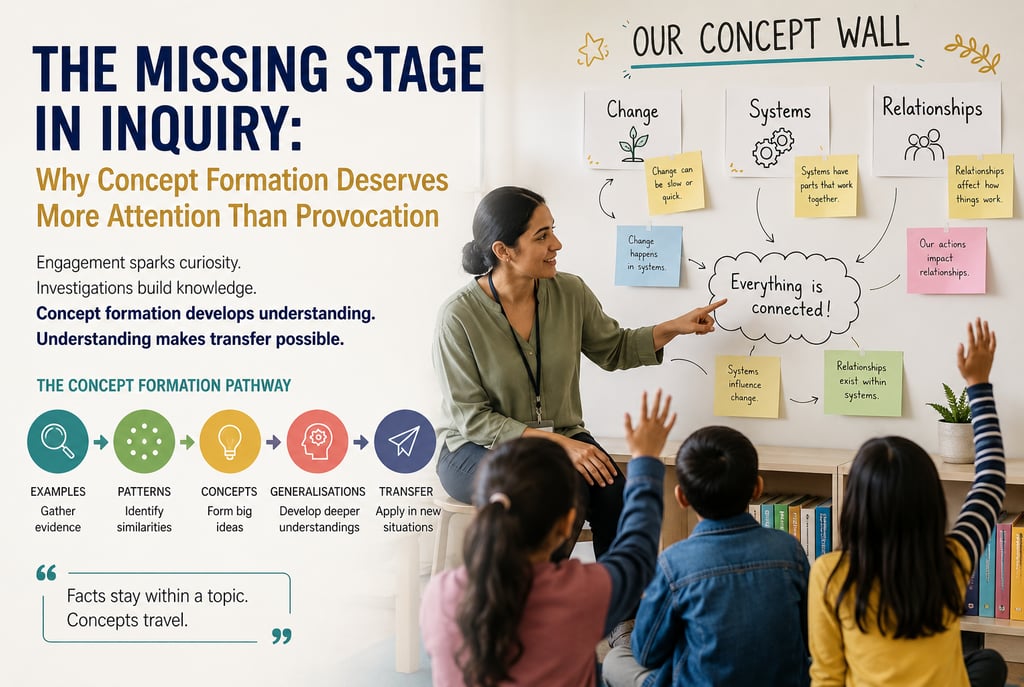
Examples → Patterns → Concepts → Transfer
Unfortunately, many inquiry experiences stop after the examples and investigations. Students explore, discuss, and gather information, but they are not always given opportunities to analyse the evidence, identify patterns, and form the concept for themselves.
That stage deserves intentional planning.
What Is Concept Formation?
Concept formation is the process through which learners examine multiple examples, identify common attributes, recognise patterns, and construct a generalisable idea.
Simply put, concept formation is turning examples into big ideas that can be used anywhere.
Rather than being told the concept, students discover it.
They compare examples. They classify information. They notice similarities and differences. They justify their thinking. They identify patterns. Eventually, they arrive at an understanding that explains the examples they have been exploring.
This process moves learning beyond memorisation and supports deeper understanding and transfer.
Why Concept Formation Matters
When students form concepts, they begin to see the world differently.
Instead of viewing information as isolated facts, they start seeing patterns and relationships. They begin connecting learning across disciplines and contexts. They realise that the same concept can appear in science, social studies, literature, mathematics, and everyday life.
More importantly, concept formation supports transfer.
A student who memorises facts about ecosystems may perform well on a test. A student who understands the concept of interdependence can apply that understanding to ecosystems, communities, families, organisations, and global systems.
The difference is significant.
Facts stay within a topic.
Concepts travel.
Concept Formation Shouldn't End When the Lesson Ends
One challenge I often see in inquiry classrooms is that concept formation is treated as a moment rather than a process.
Students identify a concept during a lesson, record it in a notebook, and then move on to the next learning experience.
But concepts become more powerful when they are revisited repeatedly.
This is where a Concept Wall can become one of the most valuable learning tools in an inquiry classroom.
Rather than displaying concepts as isolated vocabulary words, a Concept Wall becomes a living record of the thinking that has taken place throughout the year.
As students encounter new concepts, they add them to the wall. Over time, the wall becomes a visual map of their conceptual journey.
Students can revisit concepts to:
Identify patterns across units of inquiry
Make connections between subjects
Compare related concepts
Organise ideas into conceptual categories
Build increasingly sophisticated understandings
Develop conceptual understandings and generalisations
For example, a class that has explored the concepts of change, systems, and relationships may begin noticing that changes often occur within systems and that relationships influence how systems function.
These insights rarely emerge from a single lesson.
They emerge through repeated opportunities to revisit and connect ideas.
When students can physically see concepts accumulating over time, transfer becomes more visible.
The wall shifts from being a display to becoming a thinking tool.
Perhaps one of the most important questions we can ask is:
Are our learning walls displaying learning, or are they supporting learning?
A Concept Wall helps ensure that learning remains visible, revisitable, and connected.
Tannu Jain
Concept-Based Learning Trainer & Curriculum Consultant
Helping educators move beyond teaching topics to developing transferable understanding.