Make It R.E.A.L.: Rethinking Authentic Integration in the PYP
What does authentic integration really look like in inquiry learning? This article challenges the common belief that integration is about connecting subjects and explores why true integration is an inward process of connecting understanding. Discover how the R.E.A.L. Framework helps educators design concept-driven learning experiences that promote transfer, deepen understanding, and make learning meaningful across disciplines.
Tannu Jain
6/22/20264 min read
Make It R.E.A.L.: Rethinking Authentic Integration in the PYP
Why authentic integration begins with understanding, not subjects
Walk into a collaborative planning meeting and ask teachers how they integrate learning, and you will often hear responses such as:
"We integrated Mathematics with Science."
"We connected Art with our Unit of Inquiry."
"We included Language in the project."
While these statements reflect good intentions, they also reveal a common misunderstanding about integration.
Too often, integration is viewed as the process of combining subjects. Teachers look for opportunities to fit different disciplines into a unit and celebrate when multiple subjects appear within the planner.
But is that really integration?
I would argue that authentic integration is not about connecting subjects.
It is about connecting understanding.
The Integration Trap
One of the biggest challenges I observe during curriculum planning is what I call the subject-first trap.
A unit is planned.
Teachers then ask:
Where can we include Mathematics?
How can we integrate Language?
Can we connect Art to this unit?
As a result, subjects are added to the unit, but they do not always contribute to a deeper understanding of the central idea.
Students complete integrated activities without necessarily developing integrated understanding.
The result is often coverage rather than connection.
This is where authentic integration requires a different way of thinking.
Integration Is an Inward Process, Not an Outward Process
One of the most powerful shifts educators can make is recognising that integration is not something teachers do.
Integration is something learners construct.
We often celebrate integration when we see Mathematics linked to Science, Language connected to Social Studies, or Art embedded within a Unit of Inquiry.
These are visible signs of integration.
But they are not necessarily evidence of integration.
True integration is not measured by how many subjects appear in a unit plan.
It is measured by whether students are able to connect ideas and transfer understanding across contexts.
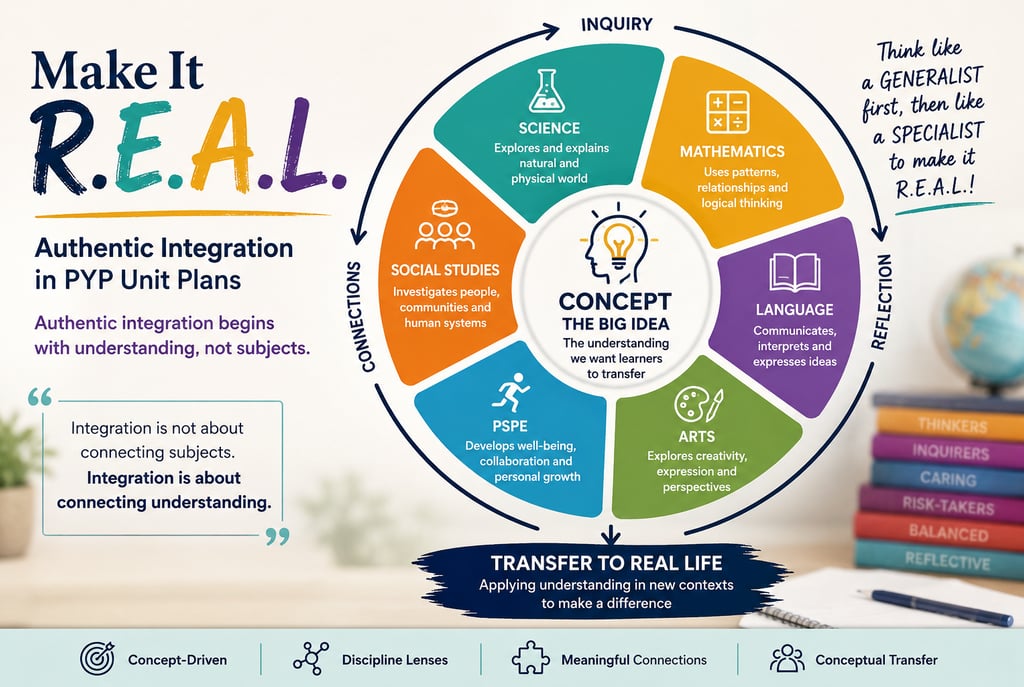
Integration is not about connecting subjects. Integration is about connecting understanding.
In other words, integration is an inward process rather than an outward process.
The outward process is what teachers plan.
The inward process is what learners construct.
For example, students may learn about:
Food chains in Science
Community roles in Social Studies
Teamwork in Physical Education
At first glance, these appear to be unrelated topics.
However, when learners recognise the concept of interdependence across all three contexts, integration begins to happen.
Students start to understand that:
Living things depend on one another.
Communities depend on people fulfilling different roles.
Teams depend on collaboration to achieve success.
The facts are different.
The concept remains the same.
This is the point where learning becomes transferable.
From Subject Integration to Conceptual Integration
Perhaps we have been asking the wrong question.
Instead of asking:
"How can we integrate subjects?"
we might ask:
"What concept do we want learners to transfer across disciplines?"
This simple shift changes the planning conversation.
Rather than viewing disciplines as separate silos, we begin viewing them as lenses through which learners explore the same conceptual understanding.
Authentic integration occurs when different disciplines illuminate a shared concept and contribute to a deeper understanding of the central idea.
The purpose of integration is not to connect subjects.
The purpose of integration is to help learners construct conceptual understandings that travel beyond subjects and into the real world.
Introducing the R.E.A.L. Framework
To support educators in designing authentic integration, I use the R.E.A.L. Framework.
The framework helps teachers move beyond subject connections and focus on conceptual transfer.
R – Recognise the Conceptual Focus
Every unit begins with a conceptual focus.
Before planning activities, resources, or assessments, ask:
What is the understanding we want students to transfer?
For example:
Theme: How We Organise Ourselves
Central Idea:
Communities develop systems to meet the needs of people.
Specified Concepts:
Systems, Function, Responsibility
The conceptual focus is not communities.
The conceptual focus is systems.
This concept becomes the anchor for integration.
E – Explore the Discipline
Once the concept is clear, identify which disciplines help learners understand the concept from different perspectives.
Ask:
How does each discipline deepen understanding of this concept?
For example:
Social Studies may explore community systems.
Science may explore natural systems.
Mathematics may explore patterns within systems.
Language may explore communication systems.
The goal is not to include every subject.
The goal is to identify disciplines that genuinely contribute to conceptual understanding.
A – Align Knowledge, Understanding and Skills
Authentic integration occurs when subject-specific knowledge and skills support the conceptual purpose of the inquiry.
Ask:
How does this learning contribute to understanding the concept?
Rather than existing alongside the inquiry, disciplinary learning becomes part of the inquiry.
Students begin seeing relationships between what they learn and why they are learning it.
L – Link and Leverage for Transfer
The final step is ensuring that learners have opportunities to transfer understanding across contexts.
Ask:
How will students use this understanding beyond the classroom?
This may occur through:
Authentic performance tasks
Interdisciplinary projects
Real-world problem solving
Student action
Community engagement
Transfer is the ultimate evidence that integration has occurred.
Think Like a Generalist First
One idea that has significantly influenced my work is this:
Think like a generalist first, then like a specialist.
As educators, we are often trained to think through the lens of our discipline.
A scientist sees science.
A mathematician sees mathematics.
A language teacher sees literacy.
But students experience the world differently.
The world is not divided into subjects.
Real-world problems require integrated thinking.
This is why planning should begin with understanding rather than disciplines.
When we start with concepts, we help students recognise patterns, make connections, and apply understanding across contexts.
Only then do disciplines become powerful tools for deepening understanding.
Making Learning R.E.A.L.
Authentic integration is not about fitting subjects into a unit.
It is about helping learners connect ideas, recognise relationships, and transfer understanding.
When planning begins with concepts:
Learning becomes connected.
Understanding becomes transferable.
Disciplines become lenses rather than silos.
Inquiry becomes meaningful.
Perhaps the next time we sit down to plan, we should ask a different question.
Instead of asking:
"How can we integrate subjects?"
Let's ask:
"What understanding are we helping students build?"
Because when understanding becomes the starting point, integration becomes real.
Reflection Questions for Educators
When planning a unit, do I begin with subjects or with understanding?
What concept sits at the heart of this inquiry?
How does each discipline deepen understanding of that concept?
Are students making connections between disciplines, or am I making the connections for them?
At the end of the unit, can students explain the transferable idea that connects their learning?
If I removed the subject labels, would students still recognise the conceptual connections?
Perhaps the ultimate test of integration is not whether subjects are connected in our plans, but whether understanding is connected in the minds of our learners.
Tannu Jain
Concept-Based Learning Trainer & Curriculum Consultant
Helping educators move beyond subject coverage to transferable understanding.