The Heart of Deep Learning: Understanding SOK and SOP
Discover the difference between Structure of Knowledge (SOK) and Structure of Process (SOP), two essential frameworks in concept-based learning. Learn when to use each, avoid common planning mistakes, and design lessons that balance deep understanding with meaningful application.
Tannu Jain
5/11/20264 min read
Introduction:
In the evolving landscape of concept-based learning, two structures often guide how educators plan and deliver lessons: Structure of Knowledge (SOK) and Structure of Process (SOP). While both are essential to designing deep and transferable learning, they serve distinct purposes. Yet, many educators unknowingly blur the lines between them, weakening the conceptual clarity we aim to build in our classrooms.
I was first introduced to the concept of SOK and SOP during my CBCI (Concept-Based Curriculum and Instruction) training. With the recent updates in the IB subject continuums, I’ve noticed a shift—a more intentional focus on SOP, which was once more implicit. The new frameworks not only stress what students should understand but also highlight the processes and skills they need to apply their learning meaningfully. This dual emphasis better equips students for both thinking and doing, which is the heart of a future-ready education.
What is SOK (Structure of Knowledge)?
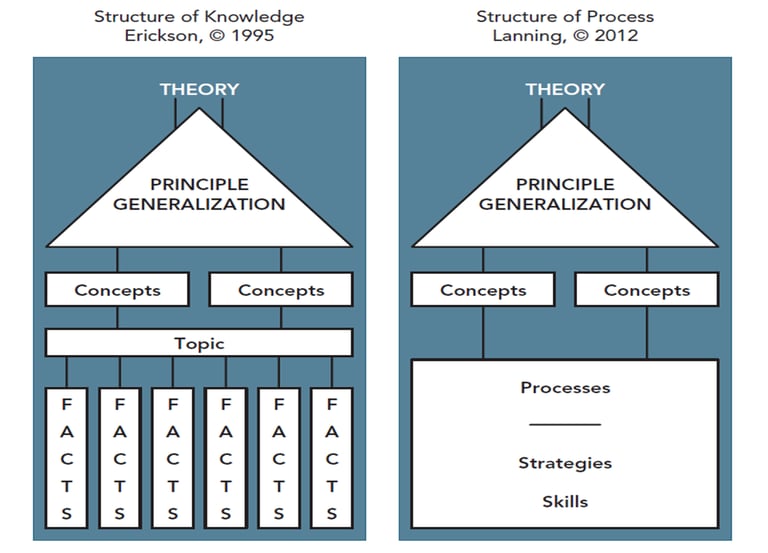
SOK helps students understand the world through concepts. It moves learners from facts to concepts and finally to generalizations, enabling them to grasp patterns, relationships, and big ideas that transfer beyond a single topic or subject.
SOK Core Flow:
· Facts: The basic knowledge (e.g., Frogs lay eggs)
· Concepts: The ideas behind the facts (e.g., Life cycle, Growth)
· Generalizations: Transferable understandings (e.g., All living things go through patterns of change)
Use SOK when your goal is to:
Build conceptual understanding
Explore ideas, relationships, or patterns
Deepen thinking about content
Develop generalizations that transfer across subjects
SOK in Action: Examples from Grades 1–6
· Grade 1 (Science):
Facts: Plants need sunlight and water
Concepts: Growth, Dependency
Generalization: "Living things depend on external conditions to grow and survive."
· Grade 3 (Social Studies):
Facts: Different communities have different rules
Concepts: Responsibility, Governance
Generalization: "Rules are created to maintain order in communities."
· Grade 5 (English):
Facts: A character changes after a major event
Concepts: Perspective, Change
Generalization: "People's actions are influenced by their experiences."
What is SOP (Structure of Process)?
If SOK is about what we understand, SOP is about what we do with that understanding. It guides students through the actions, strategies, and steps they need to take to apply what they’ve learned.
SOP Core Flow:
· Skills: The basic actions (e.g., Listening, Measuring)
· Strategies: The methods for tackling tasks (e.g., Inferring, Predicting)
· Processes: A sequence of steps (e.g., Writing process, Scientific inquiry)
· Performance: The final demonstration (e.g., Delivering a speech, Conducting an experiment)
Just like SOK, SOP can also be used to derive concepts and generalizations—but instead of being about content, they are about how learning happens.
Examples of Concepts in SOP:
· Strategy, Reflection, Fluency, Refinement, Structure, Persistence, Creativity, Decision-making, Communication, Collaboration
Sample Generalizations from SOP:
· "Effective communication requires planning, clarity, and audience awareness."
· "Revision enhances the quality of a final product."
· "Collaboration involves listening, negotiating, and adapting."
· "Strategic thinking improves performance in problem-solving."
Use SOP when your goal is to:
· Develop thinking and application skills
· Teach a process or performance
· Help students practice and refine strategies
· Scaffold real-world tasks
Examples from Grades 1–6:
· Grade 2 (Math):
Skill: Counting objects accurately
Strategy: Grouping in 10s to add quickly
Process: Solving multi-step addition problems
Generalization: "Strategic grouping supports accuracy and efficiency in problem-solving."
· Grade 4 (Science):
Skill: Measuring with tools
Strategy: Making predictions before an experiment
Process: Recording and analysing data from an investigation
Generalization: "Scientific inquiry relies on systematic observation and analysis to draw conclusions."
· Grade 6 (English):
Skill: Drafting and revising written work
Strategy: Planning before writing
Process: Writing a persuasive essay using a scaffolded structure
Generalization: "Effective writing is the result of intentional planning, drafting, and refinement."
When to Use SOK vs. SOP
It's important to note that all disciplines draw on both SOK and SOP, but the balance may shift depending on the nature of the subject. Some subjects are more conceptually driven, leaning naturally toward Structure of Knowledge (SOK), while others are more performance-based and lean toward Structure of Process (SOP).
· Sciences and Social Sciences tend to emphasize SOK because they focus on understanding systems, cause-effect relationships, and patterns.
· Languages and the Arts, on the other hand, are more inclined toward SOP because they require students to engage in processes like writing, performing, creating, and interpreting.
That said, these models are not opposites—they complement each other. A well-designed unit will often begin with SOK to ground students in understanding, and then shift into SOP for meaningful application—or vice versa, depending on the learning goal.
These models were developed by Dr. H. Lynn Erickson and Dr. Lois A. Lanning, whose work has helped educators around the world design curriculum that balances deep thinking with purposeful action.
Use SOK when…
You want students to understand big ideas
You are teaching content-heavy or concept-rich topics
You want students to make connections or generalize
The goal is understanding and transfer of concepts
Use SOP when…
You want students to perform or apply skills
You are guiding a process like inquiry or composition
You want students to demonstrate competency
The goal is performance, strategy, or product
A Common Pitfall: Mixing SOK and SOP Unintentionally
One of the biggest mistakes educators make is merging SOK and SOP without clarity. For example:
· Teaching the steps of a writing process and expecting students to develop a conceptual understanding of "voice" in the same lesson.
o ✅ Solution: First, teach the writing process explicitly using SOP (e.g., drafting, revising, editing). In a separate or follow-up SOK lesson, explore the concept of voice by analyzing how different authors use tone and perspective, then connect it back to student writing.
· Having students perform a science experiment and assume they’ve understood the conceptual principle behind it.
o ✅ Solution: Use SOP to walk students through the scientific method (question, hypothesize, test, record). Then shift to SOK by asking them to analyze the results and formulate generalizations based on patterns they observed (e.g., "temperature affects evaporation rates").
This leads to:
· Confused learning goals
· Misaligned assessments
· Shallow understanding or surface-level performance
How to Keep Them Distinct Yet Connected
✅ Plan with clarity: Ask yourself—is this about understanding an idea or learning to do something?
✅ Assess both separately: Use conceptual prompts for SOK and process-based rubrics for SOP.
✅ Integrate intentionally: Start with one structure and then build into the other. For example:
· SOK first: Understand how organisms interact → then SOP: Research and present a case study
· SOP first: Learn how to conduct interviews → then SOK: Analyze the power of voice in storytelling
Conclusion:
SOK and SOP are powerful tools in the hands of intentional educators. By understanding when and how to use each—and resisting the urge to blur them—we give students both the clarity of thought and the confidence to act. Let’s stop mixing apples and oranges. Instead, let’s serve a balanced conceptual meal.
Call to Action:
Ready to apply this thinking to your next unit plan? Try designing one lesson with a clear SOK focus and another with a clear SOP focus—and notice the difference in your students’ engagement and learning.