The Questioning Progression: What It Is, What It Isn't, and Why It Changes Everything
Many educators wonder whether the IB Questioning Progression is an ATL skill framework, a set of grade-level benchmarks, or something entirely different. In this blog, Tannu Jain unpacks the five stages of questioning—Wondering, Exploring, Focusing, Deepening, and Evaluating—and explains how questioning develops as understanding grows. Discover practical classroom strategies, visible thinking tools, and ways to nurture curiosity, deepen inquiry, and help students become thoughtful, reflective learners
Tannu Jain
6/14/20266 min read
The Questioning Progression: What It Is, What It Isn't, and Why It Changes Everything
By Tannu Jain | Concept-Based Curriculum Consultant & Certified Instructor
Since the IB released its updated learning progressions, one question keeps coming up in educator conversations — online, in staffrooms, and in the workshops, I run:
"Is the Questioning Progression part of ATL, or is it something separate?"
It's a fair question. And the honest answer is: it's both — and understanding that distinction is exactly what unlocks its potential in your classroom.
This blog is my attempt to unpack the Questioning Progression as I understand and use it: what it actually tracks, why it doesn't work the way most teachers first expect it to, and how you can use it as a living, breathing tool, not just a framework that sits in a binder.
First, Let Me Clarify the Confusion
When educators see the Questioning Progression, some immediately ask: "Is this an ATL skill tracker?" Others wonder: "Is this a grade-level benchmark? Do Kindergarteners Wonder and Grade 5 students Evaluate?"
Both assumptions are understandable. And both miss the point.
The Questioning Progression sits at the intersection of ATL Thinking and Research skills and the Learner Profile — specifically the attributes of Inquirer, Thinker, and Knowledgeable. It is supported by ATL, and it develops the Learner Profile. But it is not a checklist of skills to tick off. It is a growth progression — a map of how questioning deepens as understanding grows.
And here is the most important thing to know about it:
These stages are not age-based benchmarks. They are not grade levels.
A Grade 1 student deep inside a familiar inquiry can reach Deepening. A Grade 5 student encountering a brand-new concept may start at Wondering. The stage a student is at depends on their familiarity with the topic, the complexity of the concept, the quality of teacher support, and their prior knowledge.
Learners move flexibly between stages. And that flexibility is by design.
What the Progression Actually Tracks
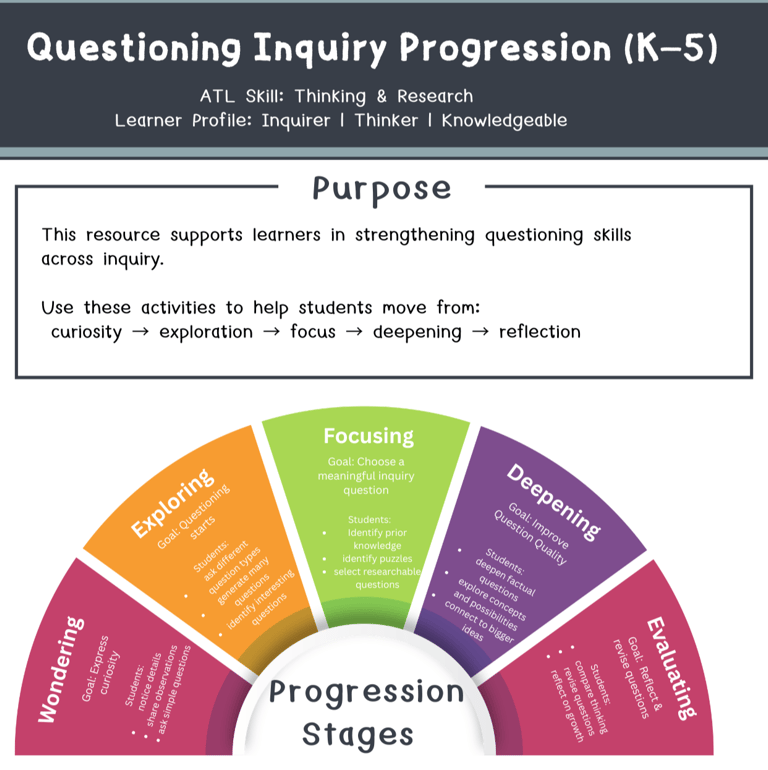
The Questioning Progression maps a journey from curiosity to reflection across five stages:
Wondering → Exploring → Focusing → Deepening → Evaluating
Let me walk you through each one — not as definitions, but as portraits of what you actually see in a classroom.
Wondering — Goal: Express Curiosity
This is where every inquiry begins, regardless of age or grade. A student at the Wondering stage notices details, shares observations, and asks simple questions in response to a provocation. Their questions are spontaneous and descriptive: "Why is the water brown after it rains?"
This isn't a weak stage. It's the essential ignition point. Curiosity is not a stepping stone to real learning — it is real learning, beginning. The big conceptual understanding embedded here is profound in its simplicity: Curiosity helps us begin learning.
As a teacher, your role at this stage is to model wonder yourself. Share your own questions. Validate every question a student asks, even the ones that seem obvious. The moment you dismiss a simple question; you teach children that their curiosity has a ceiling.
Exploring — Goal: Questioning Starts
At the Exploring stage, students move from reacting to generating. They begin asking different types of questions — not just What? but why? How? Where? When? Could? They produce many questions and start to notice which ones are more interesting than others.
A student here might say: "I have three questions — which one should I investigate?"
That moment of independent prioritisation — unprompted — is a sign of Exploring in action.
This is where tools like a Question Sort are invaluable. Asking students to sort their questions into "Easy to Find" and "Needs Investigation" builds metacognitive awareness about the value of different question types. The big understanding here: Different questions lead to different kinds of understanding.
Focusing — Goal: Choose a Meaningful Inquiry Question
Here, students move from generating questions to selecting them. This requires prior knowledge activation, identifying what they already know, spotting the "puzzles" — the places where their understanding has gaps — and choosing a question that is genuinely researchable.
A student at the Focusing stage can say: "My best question is: How far does soil travel? Because I can test it." They can justify their choice, not just make it.
This is where a Question Funnel becomes a powerful classroom tool — helping students narrow from a broad field of questions down to a single, focused, meaningful inquiry question. The big understanding: Strong questions guide meaningful inquiry.
Deepening — Goal: Improve Question Quality
This is where questioning becomes conceptual. Students at the Deepening stage move beyond factual questions and start asking How? Why? What if? — questions that connect to bigger ideas, that have more than one perspective, that cannot be answered with a quick search.
A student here might ask: "How does the connection between soil, rain, and distance affect farmers?" Notice how that question contains a concept (connection), involves multiple variables, and points toward transfer.
The Question Matrix is particularly powerful at this stage — helping students see the journey from lower-order to higher-order questioning and pushing them to frame their best question at Level 3: conceptual and transferable.
The big understanding here is one I find myself returning to constantly in my own work: Powerful questions move beyond facts to explore ideas, possibilities, and perspectives.
Evaluating — Goal: Reflect and Revise Questions
The final stage is the one most often neglected — and it may be the most important for building genuine thinking habits.
At Evaluating, students return to their original questions. They compare what they asked before to what they would ask now. They notice how their questions have changed, and they can explain why — because their understanding has grown.
A student at this stage says: "My first question was too simple. Now I'd ask: Under what conditions does erosion become a crisis?"
That shift — from a factual question to a conceptual, conditional one — is not just better questioning. It is evidence of learning. And that is the big understanding: Changing questions shows growing understanding.
The Then vs Now reflection tool captures this beautifully, and it can serve as powerful portfolio evidence, formative assessment, or a conferencing anchor.
The Most Important Idea: Questioning Is Recursive
Here is the insight that changes how teachers use this progression:
Students do not move through these stages once and finish. They cycle through them — repeatedly, across units, across years, across new concepts. Every time a learner encounters something genuinely new, they begin again at Wondering. Every time they go deeper into a familiar idea, they can reach Evaluating.
Growth in questioning is recursive, not linear.
This means the progression is not a ladder you climb and leave behind. It is a river you navigate again and again, and each time you travel it, you travel it with more skill, more awareness, and more depth.
What This Means for Teachers
If questioning is recursive, then your role as a teacher is not to push students to the "top" of the progression and declare them done. Your role is to:
Model curiosity — ask your own questions aloud. Let students see a teacher who genuinely wonders.
Validate questions — every question a student asks deserves acknowledgment. The atmosphere of your classroom determines whether students will keep asking.
Prompt deeper thinking — when a student asks a factual question, respond with a question: "That's a great start. What would you need to know to answer that? What would help you understand the why behind it?"
Make thinking visible — use the worksheets not as busywork but as thinking tools. The Notice–Think–Wonder routine, the Question Sort, the Question Funnel, the Question Matrix — each one is designed to make invisible thinking visible.
And critically: avoid answering too quickly, valuing only correct answers, and over-scaffolding every question. When we answer before students have the chance to wonder, we take away the very thing that makes inquiry meaningful.
Looking Beyond Quantity
One more shifts this progression asks of us as educators: stop measuring questioning by how many questions a student asks.
Look instead for quality evidence:
Can the student ask independently — without being told to? Can they vary their question types — moving beyond What? to Why, How, What if? Can they justify their questions — explaining why one is stronger than another? Can they deepen a question — pushing from factual to conceptual? Can they revise a question after learning — showing that their understanding has grown?
That last one is the most revealing. A student who can look at their early questions and say, "I'd ask it differently now" — that student is not just a better questioner. They are a deeper thinker.
A Closing Thought
What I love most about the Questioning Progression is what it believes about children.
It believes that curiosity is not a phase to be managed or rushed past on the way to "real" learning. It believes that a five-year-old asking "Why is the water brown?" and a ten-year-old asking "Under what conditions does erosion become a crisis?" are both doing something deeply important — and that the distance between those two questions is not age. It is experience, support, and opportunity.
Our job as educators is to create the conditions where that journey can happen — where questions are welcomed, refined, and celebrated as evidence of growing minds.
The Questioning Progression doesn't just describe how students ask better questions.
It describes how students become thinkers.
The thinking doesn't have to stop here. Download the ready-to-use student worksheets for all five stages from the Resource Library at tannusconceptcorner.com — and bring the Questioning Progression into your classroom today.
Tannu Jain is a Curriculum Consultant and Certified Concept-Based Instructor. Her resource, Questioning Inquiry Progression (K–5), is a classroom-ready toolkit of 5 student worksheets aligned to each stage of questioning growth, designed for IB PYP educators.
Available at www.tannusconceptcorner.com