
We Notice: Kindness # A shared lens the whole family holds together — not a task for one person to complete
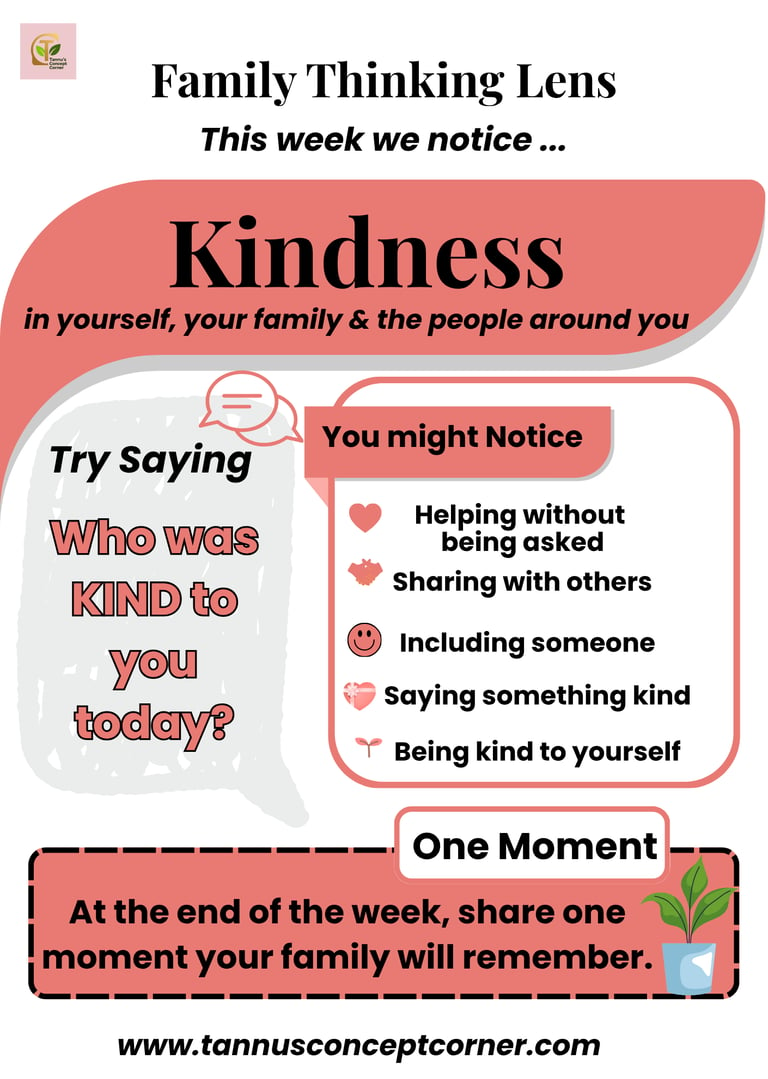
The second lens spotlight in the Family Thinking Journey series. This week's word is Kindness — noticed by everyone in the family, not assigned to any one person, and shared together at week's end.
Tannu Jain
7/11/20263 min read
"Kindness noticed once by a whole family teaches more than kindness demanded of one child."
---
This Week, We Notice Kindness
Last week's lens was curiosity — in yourself, your child, and the world around you. This week, the word changes, but the shape of the habit doesn't: one word, held loosely by the whole family, for seven ordinary days.
That "whole family" part matters more than it might seem. It's easy to design a habit like this so it quietly becomes something a parent watches for a child — an observation the adult makes, about the kid, reported back to the adult. That's not what this is. Kindness this week is being noticed in everyone: the child who shared without being asked, the sibling who let someone go first, the parent who paused a busy moment to help, even a grandparent's small gesture on a weekend call. Nobody in the family is only the observer. Nobody is only the one being observed.
You Might Notice It When…
Not as a checklist to complete — just a few shapes kindness tends to take, worth having in mind as the week unfolds:
- Someone helped without being asked — no reminder, no request, just noticing a need and meeting it
- Someone shared something — a toy, a seat, credit for an idea, the last of something good
- Someone said something that made another person feel better — a small comment, not a grand gesture
- Someone included another person who might otherwise have been left out
- Someone was kind to themselves — kindness doesn't only travel outward; a child who's gentle with their own mistake is practicing the same muscle
Try Saying
Instead of asking your child to report on their own kindness — which puts them on the spot — try opening with a question anyone in the family can answer, adult included:
**"Who was kind to you this week?"**
This one small shift changes everything about how the conversation feels. It's not "prove you were kind" — a subtly evaluative question aimed at a child. It's "notice kindness that came toward you" — which every single person in the family, from the youngest to the oldest, can answer honestly, and which quietly reveals who's paying attention to each other.
One Moment, Shared by Everyone
At the end of the week — Friday dinner, a weekend car ride, whenever your family naturally winds down — everyone shares one moment. Not a report. Not a summary of the whole week. One moment your family will remember.
This is where the "whole family" design does its real work. When a parent shares first — "I noticed your brother let you pick the show without being asked, and I thought that was really kind" — it does two things at once. It models what noticing sounds like, and it removes the pressure of being first. By the time it's a child's turn, they've already heard the shape of the thing being asked for, from someone who wasn't graded on their answer either.
Younger children's answers count exactly as much as anyone else's. "Grandma gave me the bigger cookie" is a complete, valid moment. So is a teenager's quieter observation about a friend at school. The point was never to compare whose kindness was bigger — it's that everyone, across every age in the family, took thirty seconds to notice something and say it out loud.
Why This Works Better as a Group Habit Than an Individual One
A habit that only one person in the family does — a child keeping a kindness journal alone, for instance — tends to fade within a few weeks, because it's carrying its own weight without support. A habit the whole family holds together is harder to drop, because it isn't any one person's responsibility to remember. If a parent forgets, a child might bring it up. If the week's been chaotic and nobody noticed much, saying so together — "I don't think any of us caught much kindness this week, did we?" — is itself a small, honest, shared moment, not a solo failure.
Try This This Week
At your next shared meal or car ride, ask the whole table: "Who was kind to you this week?" Go around in any order. Let the youngest person answer first if they're eager to — often, they are.
Reflection Question
*Think about the last time someone in your family was kind to you specifically. Did you say so at the time — or is this the first time it's been named out loud?*
---
What Comes Next
Next week, the lens shifts to something a little harder to spot and a little more important to name: resilience — the moments someone in your family kept going, even when it would have been easier to stop.
→ Next: This Week We Notice: Resilience
---