Your Lesson Plan Has Two Dimensions. Here's How to Add the Third.
Most lesson plans are built around activities. But activities alone don't create understanding ,they create completion. This blog explores KUD (Know, Understand, Do) as the north star of concept-based lesson planning, and why adding the third dimension — Understanding — is what turns a flat lesson into a thinking-driven experience. With cross-subject examples and a simple planning prompt, this is your starting point for designing lessons that transfer.
Tannu Jain
6/8/20265 min read
Your Lesson Plan Has Two Dimensions. Here's How to Add the Third.
By Tannu Jain | Concept-Based Curriculum Consultant & Certified Instructor & Trainer
Let me ask you something honest.
When you sit down to plan a lesson, what do you write first?
For most educators, the answer is an activity. Or a topic. Or a textbook page number. The lesson gets planned around what will happen in class — and that's understandable, because that's what we were trained to do.
But here's what that kind of planning silently produces: a 2-dimensional lesson.
Facts + Skills = Performance.
Students’ complete tasks. They answer questions. They pass assessments. And then, weeks later, they've forgotten most of it — because they never deeply understood it.
There is a third dimension that most lesson plans are missing. It doesn't require new content or a new curriculum. It requires a new question — asked before you plan anything else:
What do I want my students to Know, Understand, and be able to Do?
This is KUD. And it is the north star of every concept-based lesson.
Why Most Lesson Plans Are Flat
A teacher's job with Know is to ensure students have the raw material for thinking.
Examples: The water cycle has four stages. Migration means moving from one place to another. The numerator represents the parts out of a whole. A flat, 2D lesson plan isn't a bad lesson. It just has a ceiling.
When planning stays at the level of Know and Do — facts and skills — students can perform without ever understanding. They can simplify a fraction without knowing why equivalent quantities exist. They can label a food chain without grasping what interdependence means. They can write a paragraph using ethos, pathos, and logos without understanding that language shapes belief.
Performance without understanding is fragile. It doesn't transfer. It doesn't connect. And it fades.
The third dimension — Understand — is what makes learning durable. It's what travels with a student from one unit to the next, from one subject to another, from the classroom into life.
What KUD Actually Means
KUD is a planning framework rooted in concept-based curriculum design. I encountered it through my training with , two of the most influential voices in concept-based instruction, and it fundamentally changed how I approach a lesson.
Here is what each dimension means in practice:
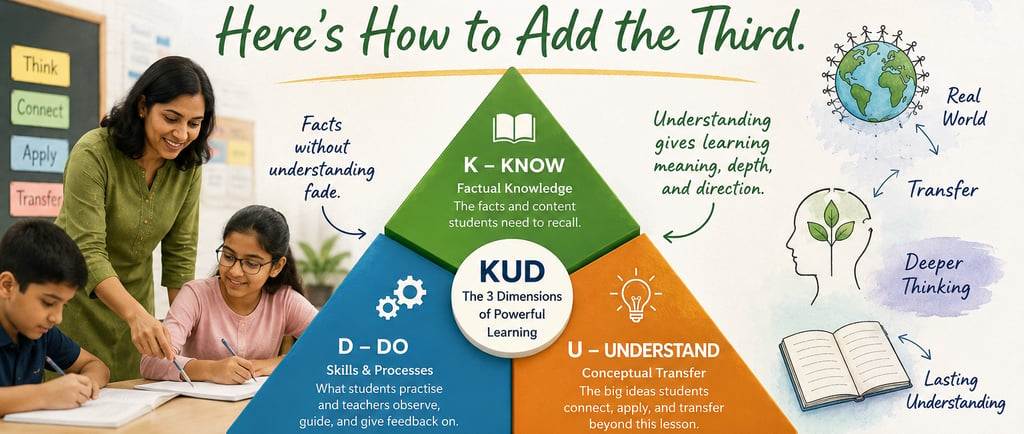
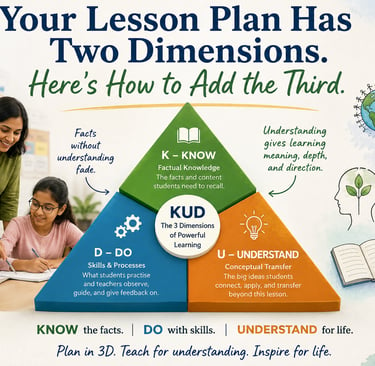
K — Know (Factual Knowledge)
What students need to recall. What teachers teach and assess as recall.
These are the facts, terms, dates, definitions, and content-specific information that anchor a lesson. They are important — you can't think conceptually about something you know nothing about. But facts alone are the floor, not the ceiling.
D — Do (Skills and Processes)
What students practise. What teachers observe, and help evolve through feedback.
Skills are active. They are not knowing something — they are doing something with knowledge. Skills need practice, modelling, and feedback to develop. They don't appear from instruction alone.
The teacher's role here is to design deliberate practice, observe with intention, and give feedback that moves students forward — not just correct what went wrong.
Examples: Comparing two sources. Justifying an answer using a model. Presenting an argument. Conducting an experiment.
Note: If you've read my blog on SOK and SOP, you'll notice that the Do dimension maps closely to what SOP addresses — the skill, strategy, and process side of learning. KUD is the planning lens; SOK/SOP are the structural frameworks that sit underneath it.
U — Understand (Conceptual Transfer)
What students connect and apply beyond this lesson. What teachers design intentionally.
This is the dimension most lesson plans skip — not because teachers don't value it, but because it requires a different kind of planning. Understanding isn't something you can deliver in a single explanation or test with a recall question. It has to be designed.
Understanding is a conceptual generalisation — a transferable, timeless statement that students arrive at through an inductive process. It's the so what of your lesson.
And here's the key: transfer has to be designed intentionally. It does not happen by accident. If you don't plan for transfer, students will perform — and then forget.
Examples:
"Equivalent fractions represent the same quantity expressed in different ways."
"Migration reshapes societies through a complex web of causes and consequences."
"Ecosystems maintain balance through the interdependence of all living things."
KUD Is Not Three Separate Boxes
Here is a mistake I see often: educators treat KUD as three separate boxes to fill — knowledge here, skills there, understanding at the end as an afterthought.
That's not how it works.
KUD is a synergy. The three dimensions work together. Facts fuel conceptual thinking. Skills give students the tools to explore and demonstrate understanding. And understanding gives facts and skills meaning and direction.
When you plan with all three in view from the start, your lesson stops being a collection of tasks and becomes a journey toward insight.
The Planning Prompt That Changes Everything
Before you write a single activity, ask yourself these three questions:
1. What do I want students to KNOW? What facts, terms, or content must they recall?
2. What do I want students to DO? What skills will they practise? What processes will they engage in? How will I observe and respond with feedback?
3. What do I want students to UNDERSTAND? What is the transferable, conceptual idea — the generalisation — I want them to arrive at? Where else does this idea show up in the world?
If your lesson objectives include all three, you are planning in 3D.
If they only include the first two, you have a 2D lesson — and your students will be able to do the work without ever understanding why it matters.
What This Looks Like Across Subjects
Let me show you the difference, using examples from across disciplines.
Mathematics
2D Objective: Simplify fractions. Identify numerator and denominator. 3D Objective: Justify fraction equivalence using models. Understand that quantities can be expressed in multiple ways.
The 3D version doesn't just ask students to simplify — it asks them to reason. And the understanding transfers: to ratios, to proportions, to scale, to the concept of equivalence in algebra years later.
Science
2D Objective: Label food chains. Define ecosystem terms. 3D Objective: Model energy flow. Understand that ecosystems are interdependent systems where balance depends on every part.
The 2D student can draw an arrow from grass to rabbit. The 3D student understands why removing one species can collapse an entire system — and can apply that thinking to supply chains, communities, and political systems.
English Language Arts
2D Objective: Identify ethos, pathos, and logos. Write using one rhetorical device. 3D Objective: Analyse persuasive strategies. Understand that language influences beliefs and actions.
The 3D student doesn't just know the terms. They understand why language is powerful — and they carry that understanding into reading the news, evaluating advertisements, and writing their own arguments.
Social Studies
2D Objective: List push and pull factors. Define types of migration. 3D Objective: Compare migration case studies. Understand that migration reshapes societies through complex, interconnected causes.
The 2D lesson produces a completed list. The 3D lesson produces a thinker who can analyse human movement across history, across continents, and in today's headlines.
A Note on Intentional Design
One of the most important things I've carried from my CBCI training is this:
Understanding is not an accident of good teaching. It is the result of intentional design.
This means the inductive approach matters. You don't hand students the generalisation on day one. You give them specific examples, concrete cases, rich experiences — and you guide them to construct the understanding themselves. When students arrive at a big idea through their own thinking, it sticks. It transfers. It's theirs.
KUD gives you the destination. The inductive path is how you get there.
Before You Plan Your Next Lesson
Here is one small shift that can change everything.
Before you open the textbook or write an activity, take 60 seconds and ask:
"What do I want students to Know, be able to Do, and deeply Understand — and how are all three connected?"
If you can answer that clearly, your lesson has a north star.
And a lesson with a north star doesn't just cover content.
It designs thinking. It designs transfer. It designs understanding that lasts.
Tannu Jain is a Curriculum Consultant and Certified Concept-Based Instructor, trained through the Concept-Based Curriculum and Instruction (CBCI) programe. She works with schools across disciplines to shift from activity-driven to thinking-driven lesson design.
Explore more at www.tannusconceptcorner.com